
Here Lies: Antonin Artaud

First published in English in Egophobia nr. 19/20, 2009.
Antonin Artaud explored, with exceptional lucidity, the relationships between representation, writing, pain, society, madness, body, and gesture. His investigations, rooted in his own experiences, proved to have a vast and later impact on art, literature, and performance, especially on the French theoretical work from the mid-1960s to the present, in the writings of Jacques Derrida, Gilles Deleuze, Hélène Cixous, or Julia Kristeva. The transmission of imageries of bodies in his writings is impaired by representation and by what Artaud calls a double trap: the dispersal of language through inarticulation, that happens when his images of the body in extreme situations are taking a textual form, and the dispersal of relevance when a text is assembled through the loss of representation.
In "Here Lies," one of his last poems, right from the start, hysterical elements come into play. As Sontag writes, we are dealing with a work that "cancels itself. [...] It is an event, rather than an object," an action that rejects language and representation in a spiraling hysterical crisis. The title itself, connected to the first line, "Here lies / Antonin Artaud," brings in a word play, an effect of pseudologia fantastica, a self-referential narrative where subjects try to draw attention from other people through lying. One of the characteristics of pseudologia fantastica is that the stories that hysterics tell are not entirely implausible and often have some element of certainty. They don't represent a form of delusion or forms of psychosis: upon confrontation, they can be acknowledged as false, they are not provoked by a direct situation or social demands. Lying has a long historical relation to hysterical behaviour. The lie in hysteria can be seen as an unconscious desire that can be easily prohibited and for this reason it contains its own annihilation, an avoidance of its own materialization.
Pseudologia fantastica is just one of the many devices that hysterics use to capture the attention of others, offering themselves as spectacles, the well-known and despised attention-seeking of hysteria. The trouble in any psychoanalytical reading is not to make a clear distinction between reality and fiction, but to see how seduction and fantasy affect subjectivity.
Starting the poem, the oedipal progression me-mummy-papa, “the stickisome trinity / of fathermother with kiddy sex” or in other words self-other-law is mixed up by the “periplum papamummy” where the self becomes “the infant wee”, an abject element that takes out the self out of the equation, denies any relation to papamummy (“I don't believe in father / in mother, / got no / pappamummy”) or identifies with feminine space, “the ass of granmummy”, anality of the mother as life-enhancing, the female principle of absorption into the mother, which explodes the oedipal connection. The crud, the gift of the child to its parents, the most inner disgusting part of the interior world, the hysterical Artaudian self, “is much more than pa and ma”. Before any possible oedipal relation that is strongly rejected, there was “the useless body”. Ironically, the distancing from Oedipus is Lacanian at its purest, "the way (as Lacanians might put it) the Symbolic order determines the positioning of the individual human subject and the way language constructs identity, the first relationship is theorized as something of the body, absorbing and 'symbiotic'." In other words, what lies here on the first page is Artaud's Lacanian Real, which can never be encountered, the condition before any limit between subject and object. The Artaudian time is before the moment of abjection, when the subject becomes aware of the gap between self and other and encounters the horror of disappearing into the abyss, as Kristeva would say. This is exactly the space that Artaud occupies, “here lies” on the margin of the abyss, staring at it, enjoying the horror show. The semiotic space comes with an inventory of feminine machinery – bodies, chaos, marginality to the Symbolic order and language, a pre-Oedipal realm where sexual difference doesn't have a shape.
The hysterical moment of "expel from the sleep of Inca / with mutilated fingers" is when this "useless body / made of meat and wild sperm / hanging" escapes itself or jumps out of the skin “to let the lawful child go free”, voiding itself to “the state of EGG… / the antiartaud state par excellence”: convulsive forces like “that sewer drilled with teeth” are seizing the body in its getaway to remake an existence free of self but “over and above the corpse / taken / from the void”. The social monstrosities, the "myrmidons of Infernal Persephone, / microbes of every hollow gesture / spittle buffoons of a dead law" are vomited, denied, expelled from the body. The visceral sensation of a mise-en-abyme of Artaud's hysterical body seems taken from one of Francis Bacon's paintings, the ones that Allon White talks about. This hysterical exercise places Artaud on the margin of the abyss: "there was no sun and no person, / no one ahead of me no one before me / no one no one no one to thou me." But even if we acknowledge that Artaud is performing in solitude, his loneliness is a shared one: his readers are present in the text and their possible rejection is already relationship. Becoming a spectacle happens when the other refuses "the free flow of mutual identification" or the so-called folie à deux, what Artaud anticipates, because, as Freud notes, the symptoms of hysterical attacks are actions, in the condition of a participating other, the audience. Artaud watchfully constructs his audience, he gives advice, he gives conclusions, he explains, he insults, he draws maps: there is always an "us" or a "you" involved. By acting in front of his audience, Artaud avoids thinking about acting, and this is why his audience is mandatory for his hysterical crisis.
The diffusion of imageries of body and pain is impaired by representation. "All true language / is incomprehensible," writes Artaud, and he tries to achieve this level of language beyond representation. Words become spells, Inca incantations or screams and in a Kleinian way, reading, "it feels like eating one's words", those that structure the I-you or subject-object relationship in a space of oneness with no demarcations. Following Kristeva, words "become performative: direct agents – erotic and in fact deadly – of a thereby disclosed hysterical intensity." In this process of thinking through the body, opposed to the rational and controlling use of language attribute of masculinity, the language does not disappear, but gains a "somnambular logic in which the animism of objects replaces the possibility of a metalinguistic evaluation of its discourse." Language is used as a mediator to the hysteric oversensitized body that is resistant to language and representation. If repressing oedipal desire contains the repression of the representation of the idea of desire, that representation becomes unconscious, and its effects are transmitted through the body. In the case of the hysteric, there is no form of representation; the "pain / sweating / inside / THE BONE" actually affects language, and the hysteric transforms it into actions of the body or unintelligible incantations.
At another level of analysis, Artaud's hostility towards representation is linked to his hostility towards social institutions or “this arrogant capitalist / from limbo and the son-in-law” (observe the pun!) that use representation to "empty the body whole, / wholly of its vitality" and put instead this “awful gimlet, / this gimlet crime, / this awful / old stud of a screwed up / deviation to the profit of the son-in-law”. As we can see in this late poem, the artistic focus on the spastic body of the hysteric in a maximum exposed and condensed form that expresses "the convulsions and jumps of a reality which seems to destroy itself with an irony where you can hear the extremities of the mind screaming" remains for Artaud the main tool to oppose representation. The subject is abandoned in the body and is repressed by being in the world. The subject discovers itself in the break with the world. To transcend the societal, tabooed, prohibited body, Artaud had to break the moral and social laws, to experience physical decadence, verbal mockery. Only when the social morality has been deliberately broken, the body becomes capable of transformation, by leaving all the laws and moral categories behind. In a Gnostic style, Artaud tried to go beyond dichotomies: good/evil, matter/spirit, body/mind, masculine/feminine, dark/light. His obsession with physical matter finds its expression in “Here Lies” and many other texts written over his last twenty years in a ruined world congested with matter in the form of shit, blood and sperm. In order to defeat the evil powers that are incarnated in matter, Artaud has to be in permanent contact with them, to submit to them and experience pain and “poisoning artaud” at their discretion, to become a monster. This puzzling “I, much more than pa and ma,” lies in front of us as a Žižekian kinder egg, an alien intruder, an excremental monster. The anal association with the self has a long history: the immediate appearance of the Inner is amorphous shit. Freud's identification of excrement as the primal form of gift, of a genuine object that the small child gives to parents, and in Artaud's case, his gift to the world, “the crud”, (as he shouts it crystal clear: “let me tell you, / all of you, you've always / made me shit”) his self in “the state of EGG”. This gesture is thus not as naive or immediately insulting as it may appear: this abject piece of self offered to the other oscillates between the sublime and not necessarily the preposterous, but specifically the excremental. This is the reason why, for the infamous Dr. L, as Artaud calls him (none other than the famous Jacques Lacan who allegedly worked on Artaud's case for a couple of months and found him incurable), one of the characteristics which distinguishes humans from animals is that for humans, the removal of shit becomes problematic exactly because it comes out from our deepest depth. The shame concerning shit is not related to its materiality but to what it represents: it exposes us, it takes out our most intimate profundity and constructs the ultimate abject barrier. This is exactly where Artaud lies: in his own excrements. This externalized shit thrown in the eyes of the world is similar to an alien monster that colonizes the Artaudian body, penetrating it and dominating it from within, and which, like in the famous scene from the “Aliens” movie, breaks out of the body through the mouth, directly through the chest or in our case, through a poem on paper.
In this undertaking, followed by his ideas of theatre of cruelty, the "psychological man, with his well-dissected character and feelings, and social man, submissive to laws and misshapen by religions and precepts", are abandoned. This abandonment is possible through expressing impulses larger than life, serving an "inhuman" subject or freedom, in opposition to the masculine liberal, sociable idea of subject or freedom. For him, the obstacle and the locus of freedom is the feminized body: never a place for pleasure but an electric capacity for intelligence and pain. The "intellectual cries" that come from his flesh are the only forms of knowledge that he can trust. “Artaud / who knew that there was no mind / but only body” conflicts with his ignorant body, a grotesque, obscene body that he depicts as “this useless body made of meat and crazy sperm”. Against this fallen body, dominated by matter, “who for an idea had an arm”, he proposes a new one: a body without organs, which he approached by transcending and intellectualizing it, in a gesture of unifying flesh and thought, renouncing “its horny stink of atoms / its randy stink of abject”. Artaud has the task here to construct this body without organs, in an alchemic way, by searching for a method to operate on the body and change one miserable matter into another enhanced kind of matter. Even if words, letters and lines seem totally out of control on the page, they follow a strategy, they create a space in which they speak in a non-linguistic form that subverts the usage of language and proves its inadequacy. The purpose of this strategy is to transmit the body and to attack back what Artaud sees as the betraying organs of the body, “nature / mind / or god.” The hysteric acts or performs even on page, Artaud's symptoms are performing to prevent thought and representation, as prerequisite of language, the male hysteric acts, enacts, performs or uses spastic language as incantations, spells, glossolalia or screaming. Juliet Mitchell argues that the hysterical body, Artaud's body without organs, is actually an absent body, even if the terror of the body becoming absent generates hysteria. The absent body cannot be represented for the subject and the paradox is that the hysteric body is the most excessively present body, but at the same time, this bodily excess depends on the subject's absence. The need for acting out and expression through the body represents an assurance that the absent body that is not felt does not become completely non-existent.
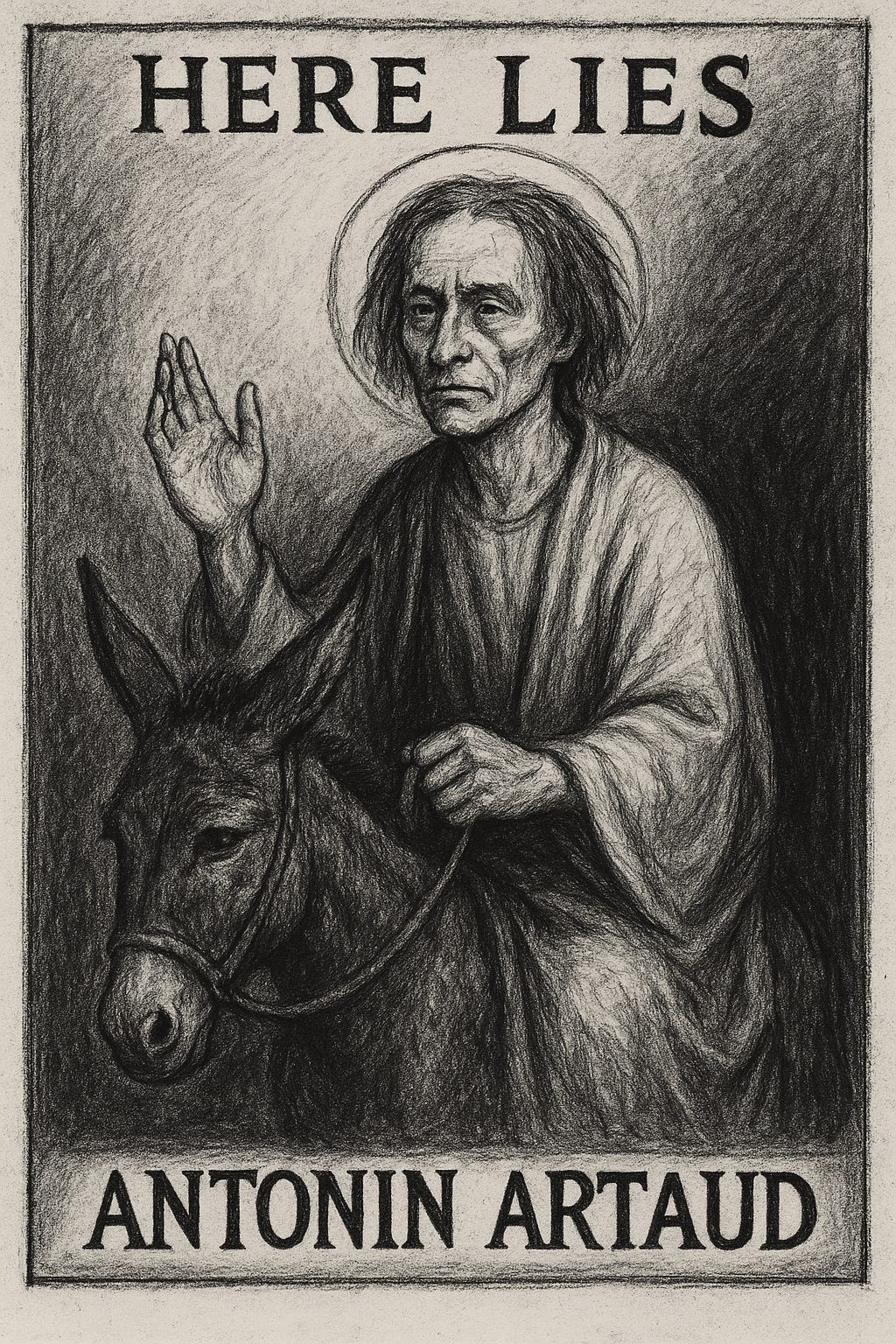
In his hysteric identification, Artaud is "Inca but no king" in a fantasized experience associated with what Keats termed "negative capability." This concept, when related to hysteria, describes a heightened receptivity where Artaud experiences the world so intensely that he becomes what he imagines. He inhabits other identities—his own corpse, a deadly plague—and most recognizably, Jesus Christ, as shown in the image of "his flight to Jerusalem on a / jackass / and the crucifixion of Artaud at Golgotha." This identification is marked by a total fusion, a plagiaristic position so complete that Artaud cannot distinguish himself from Christ. The hysterical subject collapses the boundary between self and other, and this serial identification process solicits a mirroring hysterical potential in the reader.
Through the mechanism of transference, Artaud ensures that the hysteric is never alone. Even rejection from the audience implies participation. What matters is not validation, but attention: the existence of a potential audience ready to enter a game of hysterical identification. It is this anticipation of response—even one that calls him insane and rejects his project—that sustains the spectacle. Artaud constructs his readership in advance, drawing them into a shared psychic space where fantasy and self-dissolution are performatively enacted.